

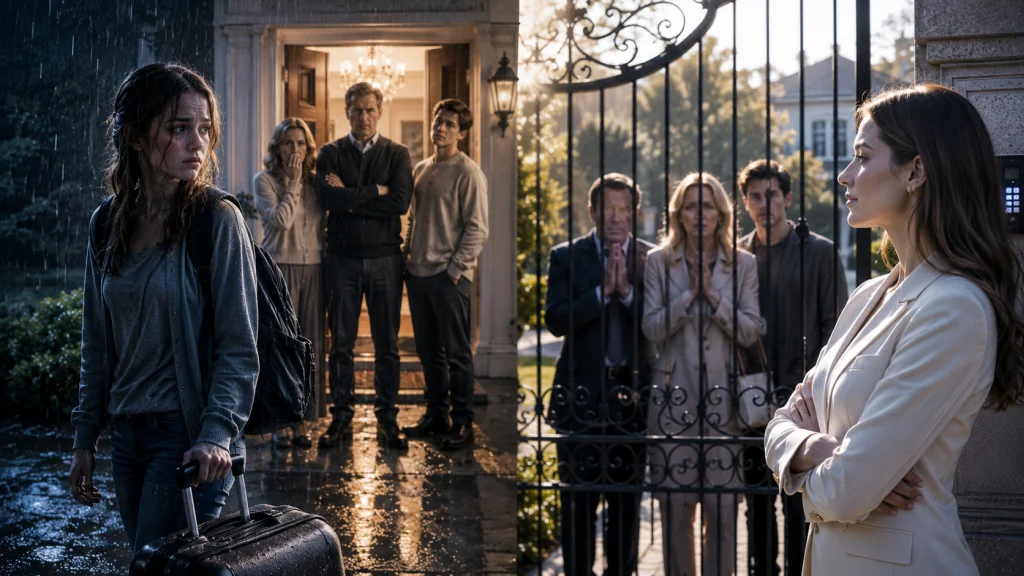
Chapter 1: They Threw My Suitcase Into The Rain
They threw my suitcase into the rain before my eighteenth birthday cake had even been cleared from the dining table.
The zip split on the front steps, and my clothes spilled into the water like things nobody wanted.
My father stood in the doorway, blocking the only warm light left in my life with one angry shoulder.
George Whitmore did not look sad. He looked offended.
As if my existence had embarrassed the house he loved more than the daughter standing outside it.
“Thieves don’t sleep under my roof,” he said.
The word thief struck harder than the rain because he said it like my name had always meant it.
My mother, Elaine, stood behind him with a tissue pressed to her mouth and her eyes full of useless tears.
She cried softly enough to look innocent.
She had always been good at that.
Crying without helping. Hurting without touching.
My brother Nathan leaned on the staircase, clean, warm, and perfectly wounded in the jumper Mum had bought him.
He had told them I stole the emergency money from Dad’s study, money kept for the company and emergencies.
He said he saw me near the drawer.
He said I was jealous of him.
He said everything except the truth.
I tried to speak, but my father lifted one finger, and the room obeyed him before I could breathe.
That finger had stopped me all my life.
At dinner. At school meetings. During every argument Nathan started and I somehow finished by apologising.
“I didn’t take it,” I said.
My voice sounded small against the storm.
Nathan looked down at the floor, safe behind the parents who always chose him before they checked anything.
Elaine whispered, “Clara, don’t make this worse.”
Don’t make this worse.
Not tell us what happened.
Not show us proof.
Not speak before we ruin you.
Just protect the son they had already chosen, even when his story had holes big enough to drown in.
I looked at my mother and asked, “You believe him?”
Her eyes filled, but she did not answer quickly enough, and that pause became louder than the storm.
That was the answer.
Then she said the sentence that finished my childhood.
“Your brother has been through enough,” she whispered, as if I was the weather and he was the victim.
Enough.
Nathan had lied, cried, and still become the wounded one, because he knew exactly which tears worked.
I had lost my home and was still expected to be gentle about the way they destroyed me.
George grabbed my schoolbag from the hall and threw it after the suitcase without even checking what was inside.
It landed in a puddle.
My books soaked through immediately.
One corner of my scholarship letter turned dark with rain.
I bent to pick it up, because paper might matter later when people finally stopped shouting.
George said, “If you walk out tonight, don’t ever come back,” like he was offering justice instead of exile.
I looked at the house once.
The windows glowed warm behind them, yellow and safe, the way family should have felt.
My mother would not move.
My brother would not confess, and my father would not read the proof I still had in my bag.
For one second, I wanted to beg, not because I was guilty, but because I was eighteen.
Then Nathan’s mouth twitched, almost a smile.
The begging died before it reached my tongue, and something colder than rain settled inside me.
I lifted my wet bag, stepped off the porch, and walked into the dark street without looking back.
One day, they would stand outside my door too, and this time I would hold the only key left anyway.