

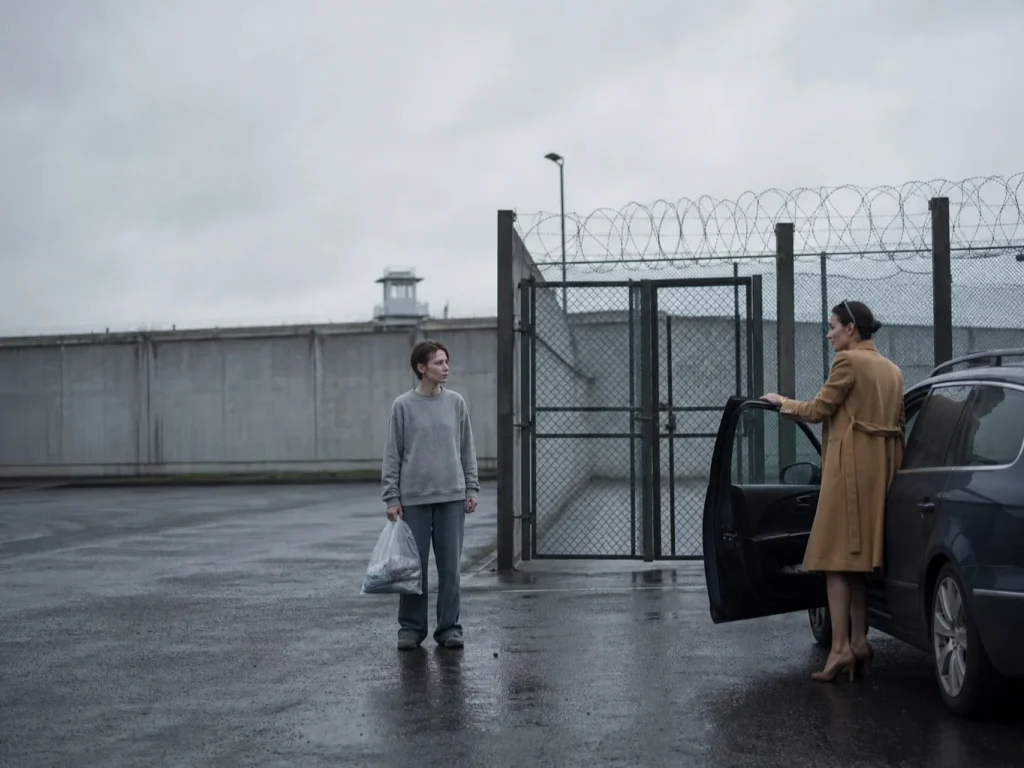
Chapter 1: The Gate
They let you out through a pedestrian gate, not the big one.
The big one is for trucks. Laundry, food, the roofing contractor who came twice a year and did nothing about the roof.
The pedestrian gate is four feet wide and grey.
I went through it at 8:14 on a Tuesday morning in March.
I know it was 8:14 because the officer said the time out loud while she wrote it down.
I was thirty.
I had been twenty-four the last time I stood on the other side of that fence.
They hand your property back in a clear plastic bag so nobody has to open it to see inside.
Mine had one pair of jeans, size 8, that no longer fit. A grey sweater. A belt with no prong. A wallet. A license four years expired. Eleven dollars and sixty cents. One hair elastic.
No phone. My phone went into evidence in the October I was twenty-four and never came back out.
What I had on was state issue. Navy trousers, white shirt, canvas shoes with no laces. Laces are a property item and property items are processed separately.
They gave me a check for two hundred thirty-one dollars and eighteen cents. Six years at thirty-four cents an hour, minus soap and stamps.
I signed for the bag.
I want to be exact about that, because of everything after.
I signed a form that said I had received the items on the list. I read the list. I did not read the date.
Then the gate.
Nobody tells you it is quiet.
No buzzer, no bell. A man in a booth presses something, the lock gives up, and you push.
I pushed.
Outside there is a strip of asphalt eleven paces wide, then a chain-link fence, then a lot for staff and visitors.
I counted them. I had counted them walking the other way at twenty-four, and I wanted to know if I had counted right.
I had. Eleven.
Thirty-nine degrees. Sun out. Old salt on the asphalt in white rings.
The lot holds about forty cars. It was a Tuesday, so it was a third full.
I had expected nobody. Nobody was what I had written down, nine or ten times that year, and it stayed nobody.
In the second row, backed in, was my car.
Dark blue. An estate car, long in the back, with a dent in the rear quarter panel I put there myself at twenty-two.
On the rear window, bottom left, a university parking sticker, sun-faded from red to pink.
I stuck it on in my second year and never took it off. You could still read half the year on it.
I stopped walking.
Not from feeling. Your body stops when what is in front of you does not match the list you keep.
I had a list. Six years of a list. Everything I owned, where it was, who was holding it.
The car was on the list. The car was in a rented garage on Vine Street, under a cover, because Dean said he would keep it under a cover.
The driver's door opened.
The woman who got out was not Dean.
She was twenty-seven that spring. I had last seen her at twenty-one, outside Courtroom 4, holding her mother's purse with both hands.
Bree Halloway. My aunt Renata's daughter. My cousin.
She had cut her hair. The kind of cut that costs money once and then costs money every six weeks after.
A camel coat, wool, belt tied instead of buckled.
Suede shoes. There was salt on the lot and she was up on her toes to keep them off it.
She shut the door with her hip, the way you do when your hands are full. Her hands were not full.
“Cass,” she said.
I did not answer.
I was looking at her left wrist.
A gold bangle. Thin, plain, no clasp, with a flat place on the underside where it had been dented and never straightened.
My mother wore that bangle for thirty-one years. They cut it off her wrist in the hospital on the second night and gave it back to me in a paper envelope with her rings.
I put it in a shoebox on the top shelf of the hall closet on Pell Street, eleven days before everything.
“You look good,” Bree said.
Nobody has ever looked good coming out of that gate.
The bag was in my right hand. I moved it to my left.
I did that so I would have a hand free. I moved the bag first and did not yet know why.
“Dean couldn't come,” she said.
I looked at the sticker. Faded red, almost pink, half a year still legible.
“He's working,” she said.
Six years. Two visits. The second ran thirty-one minutes and he spent nine of them on his phone.
“I brought the car,” Bree said, the way you say a thing you chose and wrapped.
I walked toward it.