
Chapter 3 — My Hotel
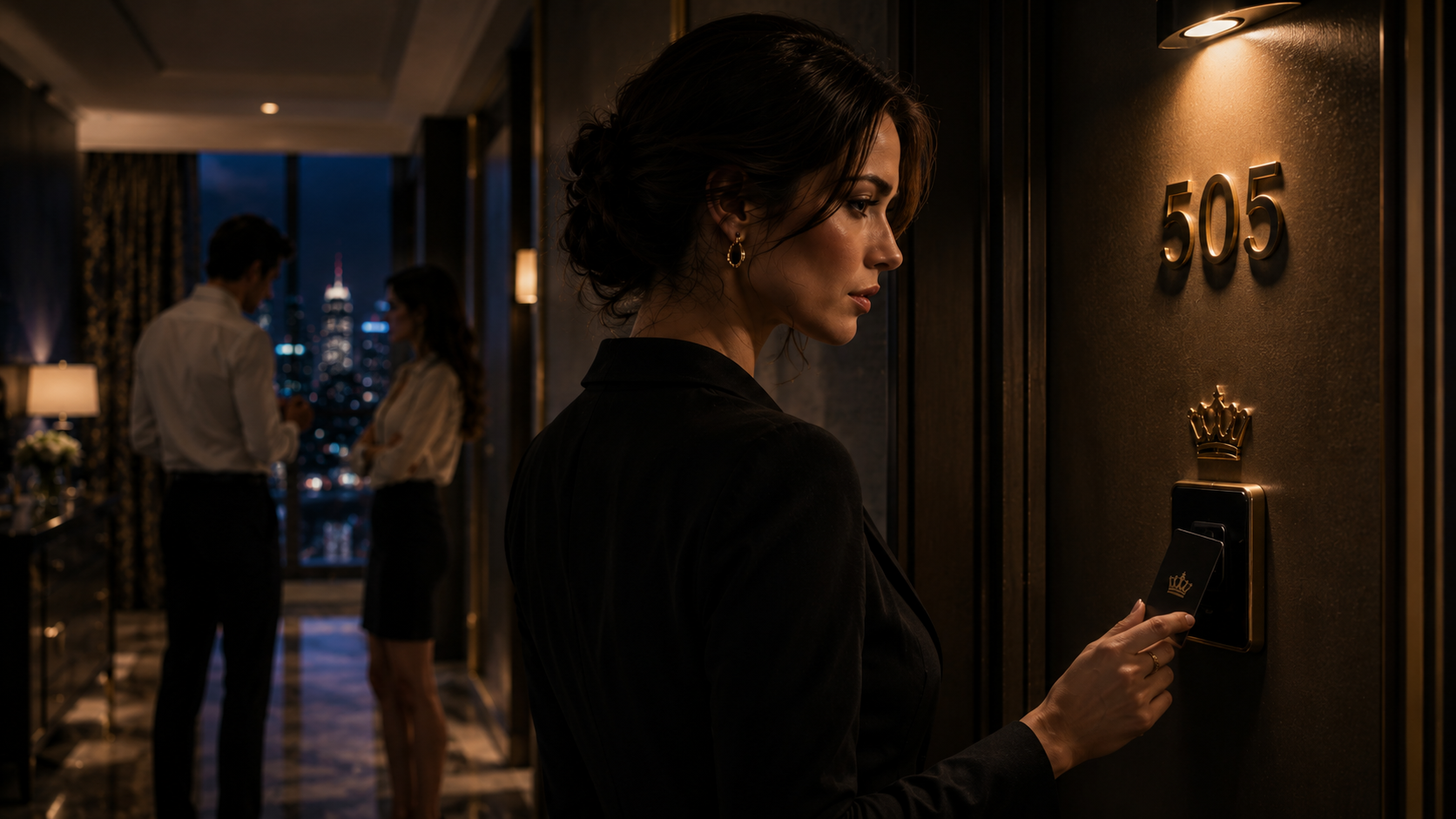
James called back in seven minutes, which is fast for a lawyer and dangerous for a husband who thinks nothing is recorded in expensive places.
James Calder did not rush for gossip, jealousy, or broken hearts, and he had seen enough of all three in my family.
He rushed for records that might disappear if a careless man realised they existed and started begging staff to be discreet.
I stood in my study doorway with the private phone in one hand.
Behind me, our anniversary dinner cooled under silver covers, still pretending to be a celebration for a marriage already entering evidence.
Across the room, Mark’s empty chair waited with perfect manners, as if it had not already testified against the man it belonged to.
“I have the booking,” James said.
His voice was no longer soft.
It was the voice he used for court filings, trust disputes, and documents that could ruin expensive men quietly before dessert.
“Read it,” I said.
Paper moved on his end of the line.
“Suite 505, Crown Hotel. Checked in at 7:18 p.m. Primary guest, Mark Hartwell, with restricted-floor access approved.”
The name did not surprise me.
The video had already done that work.
A name on a booking record is not a wound.
It is better.
It is a fact.
“Associated guest?” I asked, though the answer already stood in the room like another chair pulled too close to mine.
James paused.
That pause was almost kind.
“Chloe Reed,” he said, making her name sound smaller than the suite she had been foolish enough to film.
There she was, no longer a whisper behind a private number.
Not a rumour.
Not office gossip with perfume on it.
A name attached to a room, entered into a system designed to remember people who thought money bought forgetting and silk bought permission.
I looked at my wedding ring.
It looked suddenly administrative, a circle pretending to be romance while paperwork told the truth without needing my tears.
“How was the suite authorised?” I asked, because the room mattered less than the way he had entered it.
This time James went quiet for long enough to make the question heavier.
“Elena.”
“Say it.”
“The Hartwell family courtesy code was applied at 9:14 p.m., after the room was already occupied.”
The words cut more cleanly than the video, because desire was one betrayal and access was another.
The affair was ugly, but almost ordinary, the sort of selfishness weak men try to make private.
The code was different.
The code was access, and access was the language my family never treated casually.
It opened restricted floors, private lifts, family-tier credit, quiet billing, staff discretion, and service without ordinary questions or visible hesitation.
It was not Mark’s to give, no matter how many years he had stood beside my surname.
It was not Mark’s to lend.
It was not a toy for impressing a woman who thought luxury meant being filmed beside it and captioning someone else’s walls.
“Manual or automatic?” I asked.
“Manual. Entered after Mr Hartwell provided it to the concierge desk.”
So he had said it out loud, inside my hotel, to staff trained to honour my family’s authority and never embarrass a guest.
Good.
A spoken code had a witness, and a keyed entry had a timestamp that would not blush for him or soften for marriage.
“Preserve everything,” I said. “Booking file, lift logs, card attempts, service notes, guest amendments, concierge entry, billing pathway, and any staff remarks.”
“Already started.”
“Remove Chloe’s secondary guest privilege. Leave Mark’s primary access active until I say otherwise, and do not alert either of them.”
Somewhere across the city, Chloe still believed she had a key, and I wanted the door to teach her exactly what borrowed meant.